 blog
American Frontline vs Citadel: Security Services Compared
Table of Contents
- What American Frontline and Citadel Actually Offer Clients
- Side-by-Side Comparison: Pricing, Vetting, and Service Quality
- Questions to Ask a Security Company Before You Sign
- Hiring Security Guards for Events: What Changes
- Request a Quote from Tactical Guard Services
- Frequently Asked Questions
Last Updated: November 2, 2026
What American Frontline and Citadel Actually Offer Clients
American Frontline vs Citadel security services is a comparison most buyers approach from the wrong angle when shopping for security services. They scan websites for a list of offerings and assume the two providers are interchangeable. The real difference often shows up in how each company staffs a site, vets its guards, and structures a contract.
American Frontline is a security provider that markets guard services to commercial and residential clients. Citadel refers here to Citadel Security USA, a guard-services company, not the financial firm with a similar name. Both operate in the security industry, and both sell staffing and patrol coverage.
That gap matters. When you cannot see the operational specifics, you have to ask for them directly. Below, we break down what each provider appears to offer, then give you the questions that separate a solid security partner from a staffing agency filling slots.
Service Offerings and Client Use Cases
Both companies position themselves around guard services and security staffing. Readers weighing American Frontline can find a deeper look at alternatives for their retail use case. What a buyer needs to confirm is the depth behind that label: whether the provider supplies unarmed officers only, whether it can field an armed security officer when a site calls for one, and whether it handles access control or just walking patrols.
A common mistake is assuming every provider covers every use case. Ask each provider to name three current clients in your category before you go further.
Geographic Coverage and Local Availability
Coverage is an important point to verify with any provider. Ask how local staffing is handled, since it affects both service quality and who actually shows up at your gate.
Ask for the specific office that would service your site, the number of guards it can deploy locally, and its backup plan when a scheduled officer calls out.
Side-by-Side Comparison: Pricing, Vetting, and Service Quality
Pricing for guard services depends on the scope of coverage, so a true price comparison starts with a quote request to each provider. What you can compare before signing is how each provider builds its rate, what its vetting and licensing look like, and how it supervises and reports on the officers it places.
| Decision Factor | What to Confirm with American Frontline | What to Confirm with Citadel | Why It Matters |
|---|---|---|---|
| Pricing model | Hourly bill rate, overtime multiplier, minimum hours per shift, holiday rate | Same items, plus whether armed coverage carries a separate premium | Prevents surprise billing and lets you compare quotes line by line |
| Vetting | Background check scope, drug screening, re-screen interval | Same items, plus whether screening differs for armed vs. unarmed posts | Confirms the officer at your site meets your risk tolerance |
| Licensing | State guard license and any local permits, with proof | Same items, plus armed guard permit where required | Confirms legal compliance in your jurisdiction |
| Insurance | General liability and workers' compensation limits, certificate of insurance | Same items, plus whether subcontractors carry their own coverage | Protects you from claims and clarifies who is responsible |
| Supervision | Who supervises the site, visit frequency, reporting cadence | Same items, plus whether supervision is on-site or remote | Shows how incidents get handled and how quickly you hear about them |
| Contract terms | Length, cancellation notice, price escalation clause | Same items, plus any staffing-shortage remedies | Keeps you from being locked into a term that does not fit your site |
Pricing mechanics. Guard pricing is commonly quoted as an hourly bill rate, and the components of that rate can vary by provider. Ask each provider to explain what its rate includes.
Vetting and licensing. Licensing requirements for security officers are set at the state level, so ask each provider to confirm what applies to the officers assigned to your site.
Service quality. The factors that separate a solid security partner from a staffing agency are supervision and reporting. Ask how often a supervisor visits your site, what the incident report looks like, and how quickly you are notified of an event.
Contract terms. Read the cancellation notice, the price escalation clause, and any staffing-shortage remedy before signing. For a broader benchmark, see this buyer's guide to security guard service companies. Ask for a certificate of insurance before signing and confirm the coverage is current.
Questions to Ask a Security Company Before You Sign
The fastest way to compare two providers is a fixed question set. Ask both the same questions, in writing, and compare the answers side by side.
- Are your guards licensed in this state, and can you show proof?
- What does your background check include, and how often do you re-screen?
- Who supervises the officers assigned to my site, and how often?
- What is your response protocol for an incident, and how do you report it?
- Can you guarantee 24/7 coverage, and what is your call-out backup plan?
- What are the contract length and cancellation terms?
- What insurance coverage do you carry, and can you provide a certificate?
Watch out: a provider that hesitates on the licensing or insurance questions is telling you something. Move on.
Contact us Today for a Quote →
Before you sign anything, read how security contract terms work so you know what clauses to flag. If you want a structured walkthrough of the whole process, this guide on how to hire a professional security guard team covers it step by step.
Hiring Security Guards for Events: What Changes
Event work is a useful stress test when comparing security providers, because it exposes how a provider staffs, briefs, and supervises officers under a fixed start and end time.
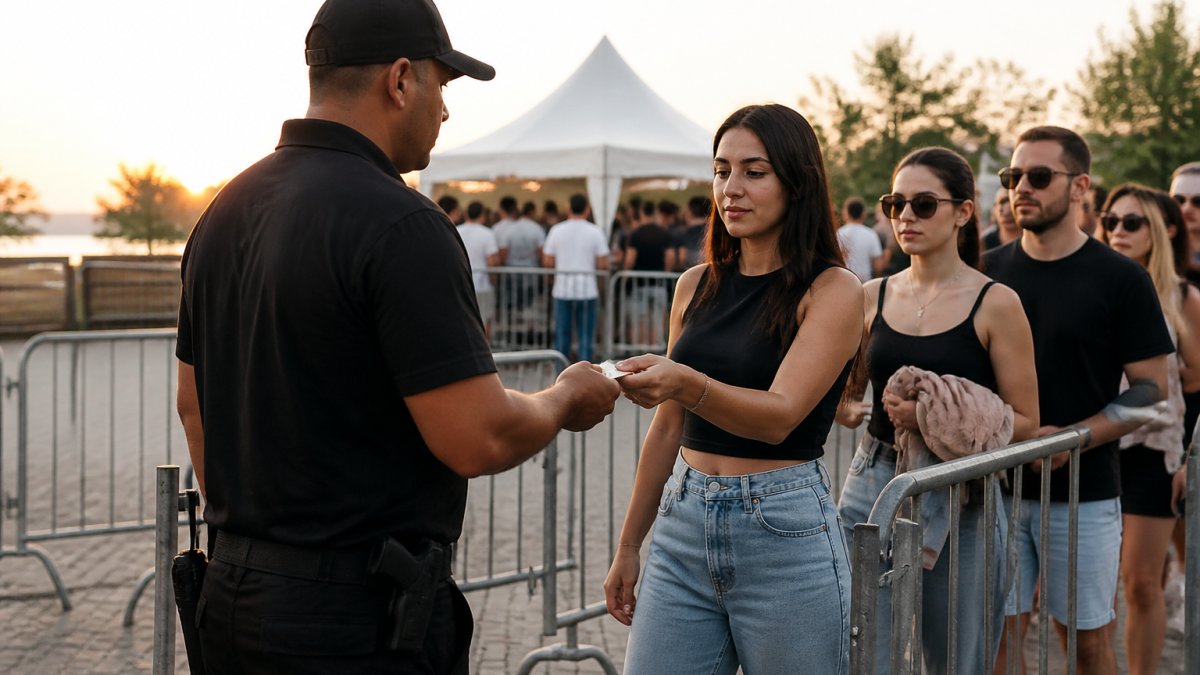
Ask both providers the same event-specific questions and compare the answers side by side:
- Can you staff the event with licensed officers, and can you show proof of the license for each officer assigned?
- How do you set the guard count per entrance, and what staffing ratio do you recommend for our expected attendance?
- Who supervises the event team, and is the supervisor on-site or remote?
- What is the incident escalation path, and how do you report incidents to the venue and to us?
- What is your backup plan if a scheduled officer calls out on the day of the event?
- What are the contract terms for a one-day event, including cancellation notice and overtime?
A workable event plan names every post, every officer, and every escalation step. Model yours on three common patterns: a single-entry checkpoint for controlled-access events, a perimeter-plus-interior patrol for open venues, and a VIP close-protection layer for high-profile gatherings. Each pattern changes the staffing count and the briefing you give the team, and each provider should be able to describe how it would staff all three.
For a deeper look at the process, this guide on hiring security guards for events walks through planning, staffing ratios, and day-of coordination. Below is the checklist we would use to brief any event team, and it doubles as a comparison tool: ask each provider to walk through it with you.
Event Security Staffing Checklist
- Confirm the venue's own security rules and any union requirements
- Map entry points, credential zones, and restricted areas
- Set the guard count per entrance based on expected attendance
- Assign a site supervisor with a direct radio channel
- Write the incident escalation path and share it with venue staff
- Confirm arrival time, briefing time, and post-event debrief
Event Security Plan Examples to Model
A single-entry checkpoint works for controlled-access events and keeps credential checks in one place. A perimeter-plus-interior patrol suits open venues where attendees move between areas. A VIP close-protection layer adds officers who stay with a principal and coordinate with the venue's own staff. Ask American Frontline and Citadel to describe how they would staff each pattern for your event; the specificity of the answer is a good proxy for how they staff a standing post.
Request a Quote from Tactical Guard Services
Comparing providers on paper only gets you so far. The real test is whether a company can staff your site, vet its officers properly, and answer your questions without hesitation. That is the standard we hold ourselves to at Tactical Guard Services.
We provide professionally licensed security service with 24/7 on-site operation, and we offer affordable pricing. Contact us today for a quote. Our team focuses on protecting homes and businesses with reliability and care, so you get peace of mind rather than gaps in the schedule.
Get started with Tactical Guard Services and request a quote for your site today.
Frequently Asked Questions
Is Citadel Securities the same as Citadel Security?
No. Citadel Securities is a financial-services firm, while Citadel Security USA is a guard-services provider. The two are frequently confused in search results, which is why comparing security services requires checking the company's actual service offerings, licensing, and client base rather than relying on a name match. Confirm the legal entity name on the contract and verify the license with the state regulator before signing.
What services do American Frontline and Citadel Security offer?
Guard services can vary by branch and contract. Ask for a written scope covering armed versus unarmed officers, patrol frequency, access control, monitoring, and reporting. Request references from clients with similar sites, such as a gated community or a retail store, so you can judge service quality against your own use case rather than a generic brochure.
How do I compare security guard companies for an event?
Start with a staffing checklist: headcount by zone, armed or unarmed roles, credential checks, radio protocol, and an emergency escalation plan. Ask each provider for event security plan examples and confirm insurance limits and licensing in the event's jurisdiction. Pricing depends on hours, headcount, and threat level, so request itemized quotes and compare what is actually included rather than the bottom-line number alone.
What should I ask a security company before hiring guards?
Ask how officers are vetted, what training they complete, who supervises them on site, and what happens when a guard calls out. Confirm 24/7 coverage in writing, response times for alarms, and contract exit terms. Request the license number and certificate of insurance, then verify both with the state. A provider that answers these questions directly, in writing, is easier to hold accountable than one that only promises reliability.