 blog
Best Security Guard Service Companies: 2026 Buyer's Guide
Table of Contents
- What Separates the Best Security Guard Companies
- How to Hire a Security Guard Company Without Getting Burned
- Security Guard Company Cost: What Drives Your Quote
- Security Guard Services for Businesses by Property Type
- Armed Security Guard Services: When They Make Sense
- Licensing, Insurance, and Background Checks to Verify
- Service-Level Agreements and How to Measure Performance
- Conclusion
- Frequently Asked Questions
Last Updated: October 19, 2026
What Separates the Best Security Guard Companies
Finding the best security guard service companies starts with one hard truth: the uniform tells you almost nothing.
Here's how to screen providers so that doesn't happen to you.
A security guard company is a licensed firm that supplies trained personnel to protect people, property, and assets, on-site or through patrol routes. The best ones treat that as a floor, not a ceiling.
The Five Criteria That Actually Matter
Most buyer's guides list twenty factors. Five do the real work:
- Licensing and insurance in the state where guards will work, verifiable in writing
- Hiring and training standards, including background checks and ongoing refresher training
- Supervision structure, meaning who checks on the guards and how often
Everything else, from uniforms to fleet vehicles, is presentation. These five decide whether your site is protected.
How to Hire a Security Guard Company Without Getting Burned
Hiring fails when buyers treat it as a price comparison. It's a risk transfer decision. Here's the sequence we recommend for how to hire a security guard company:
- Define the post before you call anyone. Write down hours, days, number of guards, and specific duties. "General security" gets you a generic quote.
- Request a site assessment. A serious provider walks the property before pricing it. A provider that quotes from a phone call is guessing.
- Verify licensing and insurance directly. Ask for the license number and certificate of insurance, then confirm both with the state and the insurer.
- Ask for post orders. These are the written instructions guards follow on site. Review them before signing, not after.
- Check references from similar properties. A warehouse reference tells you little about retail loss prevention.
- Read the termination clause. Know your notice period and any cancellation fees before you commit.
The most common mistake is skipping step one. Vague scopes produce vague service, then arguments over expectations that were never written down.
Security Guard Company Cost: What Drives Your Quote
Security guard company cost depends on guard type, hours, site risk level, and local labor rates, so two properties on the same street can get very different quotes. Here's how the bill is built so you can sanity-check any proposal.
How Guard Pricing Is Built
Almost every guard contract is priced as an hourly bill rate times scheduled hours, plus pass-through items. The bill rate is not the guard's wage: it's the wage plus payroll taxes, workers' comp, general liability insurance, uniforms, equipment, supervision, training time, and the provider's margin. As a rule of thumb, the bill rate runs roughly 1.5 to 2.0 times the guard's hourly wage.
Typical Bill-Rate Bands by Guard Type
These are planning ranges, not quotes. Actual rates vary by state, city, union status, and contract length; any provider giving a firm number without a site walk is guessing.
| Guard Type | Typical Hourly Bill Rate | Typical Annual Cost for One Full-Time Post (2,080 hrs) |
|---|---|---|
| Unarmed, low-risk site | $25-$40/hr | $52,000-$83,000 |
| Unarmed, high-risk or high-traffic site | $35-$55/hr | $73,000-$114,000 |
| Armed officer | $40-$75/hr | $83,000-$156,000 |
| Mobile patrol visit (per stop) | $25-$60 per visit | Varies by frequency |
| Event guard (short shift) | $35-$75/hr with 4-hour minimums | Project-based |
Treat these as order-of-magnitude checks. $18/hr for an armed post in a major metro is a warning, not a bargain; $90/hr for an unarmed gatehouse in a low-cost market deserves a line-item explanation.
The Cost Drivers That Move the Number Most
| Cost Driver | What It Means | How to Control It |
|---|---|---|
| Guard type | Armed officers cost more than unarmed | Match the credential to the actual risk |
| Coverage hours | 24/7 multiplies base cost | Use patrol visits for low-traffic overnight hours |
| Site risk level | Higher-risk sites need senior staff | Address physical vulnerabilities first |
| Overtime and holidays | Premium rates apply | Build a coverage calendar up front |
| Contract length | Longer terms often earn lower rates | Trade term length for a rate hold, not for weaker SLAs |
| Technology add-ons | Cameras, access control, monitoring | Bundle where it replaces guard hours |
Line Items That Quietly Inflate Invoices
When comparing quotes, normalize them: ask each provider to price the same hours, duties, and supervision level. Watch for these add-ons that push the effective rate above the headline number:
- Holiday and overtime premiums billed at 1.5x or 2x the base rate
- Supervision fees charged separately from the guard rate
- Uniform and equipment charges passed through monthly
A low quote often excludes supervision, uniforms, or replacement coverage for call-offs. Ask for a sample invoice with a full month of charges, not just the rate sheet.
Security Guard Services for Businesses by Property Type
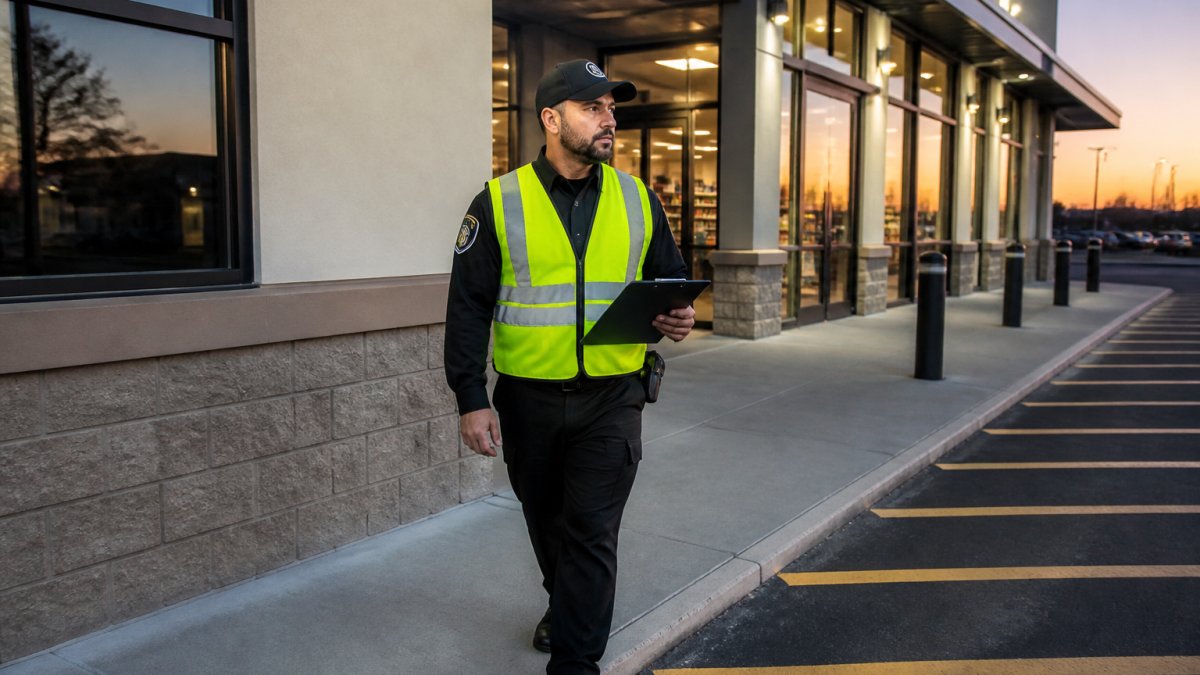
Security guard services for businesses are not interchangeable across property types. A data center and a shopping center need different skills, credentials, and post orders.
Match the Provider to the Property, Not the Brochure
| Property Type | Core Duties to Specify in Post Orders | Credentials to Verify | Common Failure Mode |
|---|---|---|---|
| Retail | Visible deterrence, loss-prevention observation, non-escalating shoplifting response, closing procedures | Unarmed by default; state-specific training | Guards who confront instead of observe and report |
| Corporate offices | Access control, visitor logging, reception coverage, after-hours patrol | Unarmed; professional appearance standards | Reception coverage that drifts into personal errands |
| Construction sites | After-hours patrols, gate logging, material and equipment theft deterrence | Unarmed; sometimes K-9 patrol | Patrols that log the gate but never walk the fence line |
| Residential communities | Gatehouse staffing, visitor screening, overnight patrols, rule enforcement | Unarmed; HOA or community association experience | Guards who waive in unfamiliar vehicles |
| Healthcare | Access control, de-escalation, coordination with clinical staff | Unarmed or armed per facility policy; de-escalation training | Officers untrained in patient-interaction protocols |
| Critical facilities and data centers | Strict access protocols, escort procedures, detailed incident documentation | Unarmed; background checks at higher tier | Documentation gaps that fail audit |
| Events | Crowd management, bag checks, credential verification, egress support | Unarmed or armed per event risk assessment | Understaffing at peak ingress and egress |
The Post-Order Questions That Reveal Real Experience
Ask any provider to describe their experience with your property type, then push for specifics. General commercial clients are not the same as a manager who has run a gated community for years. These questions separate the two:
- "Show me a sample post order for a site like mine." A provider with real depth in your property type will have one ready. A generalist will promise to customize later.
- "What does your guard do in the first 15 minutes of a shift?" The answer should reference a specific checklist, not "patrol the property."
- "How do you handle a shoplifting incident without escalation?" For retail, the correct answer is observe, document, and report, not detain.
When to Combine Guards With Technology
For many property types, the right answer is a blended program, not more guard hours. Remote video monitoring can cover low-traffic overnight hours at a fraction of an on-site post, freeing budget for visible guard presence during high-risk windows. Access control reduces gatehouse workload, and integrated incident-reporting platforms make documentation auditable. Ask whether the provider offers these integrations or partners with a monitoring firm, and whether guard and monitoring teams share a single incident log.
Armed Security Guard Services: When They Make Sense
Armed security guard services fit situations with a credible threat of violence or high-value assets at risk: certain financial sites, jewelry and high-value retail, some healthcare settings, and elevated-risk events.
Armed officers carry more legal exposure, require more training and stricter licensing, and cost more.
Contact us Today for a Quote →
The decision comes down to three questions:
- Is there a documented threat that unarmed presence cannot address?
- Does state law permit armed guards at this site type?
- Can the provider show training records and range qualifications for each armed officer assigned?
If any answer is unclear, stay unarmed and invest in access control and surveillance instead. Armed response is a specialized tool, not a badge of quality.
Licensing, Insurance, and Background Checks to Verify
Verification is where buyers get lazy, and it's where the best security guard service companies separate from the rest. Every state licenses private security firms and sets its own training and registration requirements, so confirm the rules for your state through the relevant state licensing authority or your state's official regulatory site.
Your checklist before signing:
- Company license number, confirmed with the state regulator
- Certificate of insurance showing general liability coverage
- Workers' compensation coverage in force
- Background check policy for guards, in writing
For broader context on private security standards, the ASIS International guidelines are a useful reference point for what professional programs include. Insurance matters as much as licensing: if an officer is injured or causes damage on your property, you want clear coverage, not a dispute about who pays.
Service-Level Agreements and How to Measure Performance
A service-level agreement turns promises into measurable commitments. Without one, "24/7 coverage" is a marketing phrase. With one, it's a clause you can enforce.
What a strong agreement includes:
- Coverage guarantees with defined replacement procedures for call-offs and no-shows
- Response times for alarm activations and incident escalation
- Reporting cadence, such as daily activity logs and monthly summary reports
- Supervision frequency, meaning scheduled site visits by a supervisor
Measure performance monthly, not annually. Review logs against post orders, spot-check patrol timestamps, and ask for turnover numbers.
This is where the best security guard service companies behave differently: they bring you the numbers before you ask for them.
Conclusion
The hardest part of hiring protective services isn't finding providers; it's telling them apart before you've signed and lived with the results. Licensing, supervision, documentation, and honest reporting are the signals that matter, and they're all verifiable if you ask the right questions.
At Tactical Guard Services, we built our service around those signals: professionally licensed security service, 24/7 on-site operation, and affordable pricing. We protect homes and businesses.
Contact us Today for a Quote
Frequently Asked Questions
How much does private security cost per month?
There is no single monthly rate. Pricing depends on hours covered, armed versus unarmed officers, site risk level, and whether you need patrols or a fixed post. A single unarmed overnight post costs far less than round-the-clock armed coverage at a multi-building site. Ask every provider for a line-item quote that separates hourly labor, supervision, equipment, and any technology fees so you can compare like for like. Request a quote from Tactical Guard Services for figures tied to your specific property.
How do I find a reputable security guard company?
Start with licensing. Ask for the company's state license number and confirm it with the state regulator that oversees private security. Then request a certificate of insurance showing general liability and workers' compensation coverage, and ask how guards are screened and trained before their first shift. Check customer reviews for complaints about missed shifts or slow response, and ask for references at properties similar to yours. A trusted provider will hand over all of this without hesitation.
What should I look for when hiring security guards?
Look for four things: verified licensing and insurance, documented guard training, a written post order describing exactly what officers do each shift, and a supervision structure that includes site visits. Ask how the company handles call-offs and whether it guarantees 24/7 coverage without schedule gaps. Get response-time commitments in writing. Reliable service shows up in the contract terms, not the sales pitch.
What types of security guard services are available?
Most companies offer unarmed officers for access control and patrol, armed officers for higher-risk sites, mobile patrol for multiple locations, event security for gatherings, and construction site security for equipment and material protection. Many also bundle technology such as camera monitoring and access control with on-site personnel. The right mix depends on your property type and risk assessment, so ask each provider which services they deliver with their own employees rather than subcontractors.
This guide was prepared by Tactical Guard Services to help property owners and managers compare security providers on substance rather than sales pitch.