 how-to
How to Hire a Professional Security Guard Team
Last Updated: November 1, 2026
Quick Summary
To hire a professional security guard team, assess your site in person, calculate post coverage with relief officers, and verify state licensing and insurance before signing. Compare quotes on identical scope, including supervision, replacement coverage, and reporting terms, not hourly rate alone.
- A security guard team is a coordinated group of licensed officers under one contract, sharing post orders and supervision.
- Calculate coverage by multiplying posts by hours, then add relief coverage for breaks, callouts, and overtime.
- Verify state license numbers, general liability limits, workers' compensation coverage, and background check standards.
- Confirm minimum hours per shift, replacement coverage guarantees, and escalation contacts in writing before ranking proposals.
- Compare quotes on the same posts, hours, and relief coverage, since a lower rate with thinner supervision is a different product.
Table of Contents
- How to Hire a Security Guard for Your Business or Property
- Armed vs Unarmed Security Guards: Which Fits Your Risk
- Security Guard Company Licensing and Insurance: What to Verify
- Security Guard Service Agreement Checklist
- What Security Guard Coverage Costs and How to Compare Quotes
- Request a Consultation With Tactical Guard Services
- Frequently Asked Questions
How to Hire a Security Guard for Your Business or Property
With that many options, hiring well comes down to process, not luck. This guide shows you how to hire a professional security guard team the right way: assess the site, size the coverage, verify licensing, and compare quotes on equal terms. For a broader comparison of providers, see this buyer's guide to security guard companies.

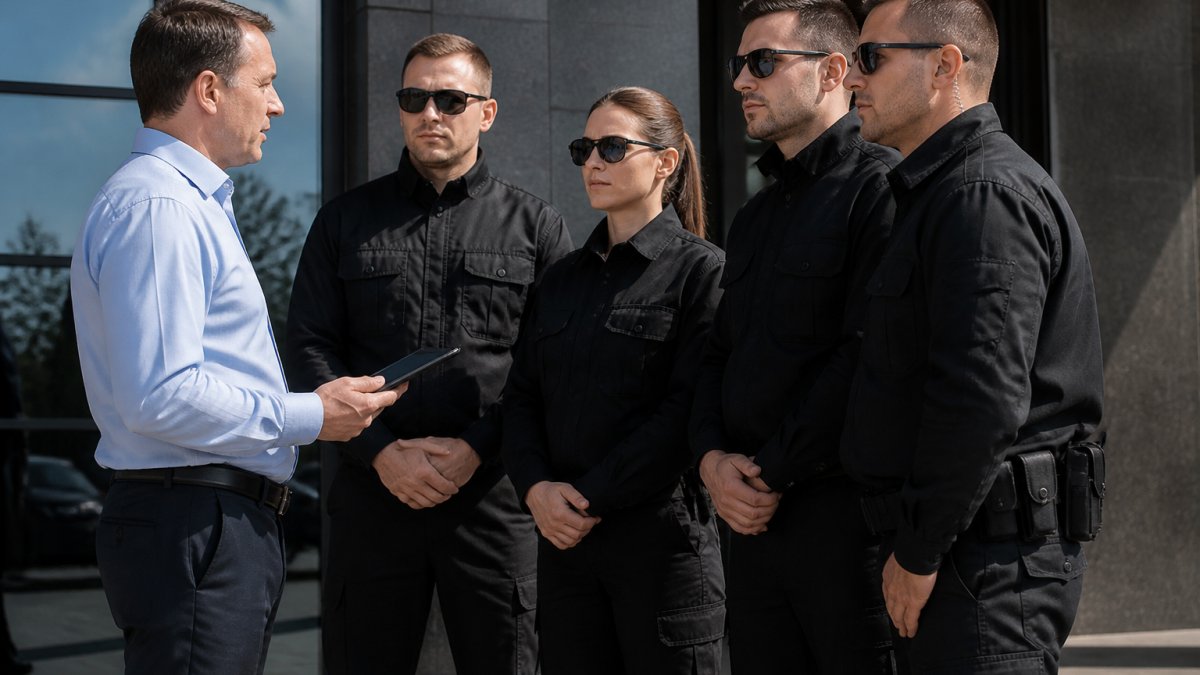
A security guard team is a coordinated group of licensed officers assigned to a property under a single contract, rather than a rotating cast of individuals. That distinction matters. Teams share post orders, supervision, and reporting, which is why they produce consistent coverage instead of gaps.
Define Your Security Needs With a Site Assessment
Start with a walkthrough, not a phone call. A site assessment maps entrances, blind spots, lighting, access control points, and after-hours exposure. Property managers who skip this step end up buying patrol hours they don't need and missing the risks that actually matter. Ask every provider to document findings in writing before quoting.
Risk and response expectations belong in the same conversation. To set realistic expectations, learn what a good emergency security guard response time looks like.
Calculate Staffing Levels and Post Coverage
Staffing math is where most budgets go wrong. Coverage is calculated by multiplying posts by hours, then adding relief coverage for breaks, callouts, and overtime. A single 24/7 post requires more than one full-time officer, not one person working around the clock.
- Count fixed posts first (lobby, gatehouse, dock)
- Add patrol frequency and route length
- Factor in relief officers for every 24/7 assignment
- Build in a buffer for sick days and turnover
Armed vs Unarmed Security Guards: Which Fits Your Risk
Armed security suits high-value assets, cash handling, and sites with elevated threat profiles. Unarmed security fits access control, loss prevention, patrol, and most residential and office settings. Choose based on documented risk, not appearances. Armed officers carry additional licensing, training, and insurance requirements, and they change how your site is perceived by visitors.
For most retail stores and gated communities, trained unarmed guards paired with strong access control prevent more incidents than a visible firearm. Event security is the middle ground: match the guard type to the crowd, the venue, and the threat assessment.
Security Guard Company Licensing and Insurance: What to Verify
Licensing and insurance verification is the step buyers rush, and it's the one that protects you. Every guard should hold a current state license, and the company should carry general liability and workers' compensation coverage. Request certificates directly and confirm they're current.
- State license numbers for the company and assigned officers
- General liability limits and certificate of insurance
- Workers' compensation coverage
- Background check and training standards for guards
- Written post orders and supervision structure
a median hourly wage of $19.44 for security guards (BLS occupational wage data for security guards(https://www.bls.gov/oes/2023/may/oes339032.htm)). That's a worker wage, not a billing rate. If a quote lands far below local wage levels, the savings usually come from training, supervision, or insurance, and you'll feel it later.
Security Guard Service Agreement Checklist
A security contract should spell out scope, staffing, supervision, and termination terms in plain language. Before signing, confirm the agreement covers post orders, relief coverage, incident reporting, insurance, and cancellation notice. Vague contracts create disputes over exactly the things you hired guards to prevent.
Contact us Today for a Quote →
Most buyers compare proposals on hourly rate alone. That is the wrong unit. The terms below determine what you actually receive, and they are where providers differ most, and where the least specific proposal usually wins on price and loses on service.
Scope and Staffing Terms
- Scope of services and post locations, listed by post
- Guard-to-post ratio and relief coverage, with the staffing math shown
- Armed or unarmed designation for each post
- Supervision structure and site visit frequency
- Written post orders for each post, attached as an exhibit
Service-Level Expectations
These are the terms that separate a professional team from a warm body at a desk:
- Minimum hours per shift or per week. Many providers bill a minimum (commonly four hours) even if the assignment ends early. Know the floor before you sign.
- Cancellation and rescheduling notice. Ask how much notice is required to cancel a shift without charge, and whether the same notice applies to holiday coverage.
- Replacement coverage. Confirm in writing that the provider guarantees a replacement officer for callouts, and how quickly. Ask who covers the post if a replacement cannot be found.
- Escalation procedure. Get the names and response times for the on-site supervisor, the account manager, and the after-hours duty contact. A 24/7 operation needs a 24/7 escalation path.
- Incident reporting. Specify the format, what triggers a report, and the delivery timeline, same shift, next business day, or weekly summary. Ask whether reports include photos and a written narrative.
- Performance review cadence. Monthly or quarterly reviews with a defined scorecard keep the relationship measurable.
Commercial and Exit Terms
- Rate schedule including overtime, holiday, and short-notice rates
- Insurance certificates attached, with limits and additional-insured status confirmed
- Termination notice period and exit terms, including transition of post orders
- Indemnification and liability allocation
- Data and records ownership, who keeps incident logs and for how long
For a clause-by-clause walkthrough, see security company contract terms explained before you sign.
Questions to Ask Before You Sign
Ask how coverage gaps are prevented, who supervises the guards, and what happens when an officer calls out. Ask for the response protocol for a break-in and the reporting you'll receive after an incident. Ask whether the company handles access control and monitoring or only patrols. If a provider can't answer these specifically, that's your answer.
What Security Guard Coverage Costs and How to Compare Quotes
Compare quotes on the same scope: same posts, same hours, same relief coverage. A lower hourly rate with thinner supervision isn't cheaper, it's a different product.
| Quote Factor | What to Compare | Why It Matters |
|---|---|---|
| Hourly rate | Base, overtime, holiday | Overtime spikes surprise budgets |
| Relief coverage | Included or billed extra | Gaps appear without it |
| Supervision | Visit frequency | Unsupervised posts drift |
| Insurance | Limits and certificates | Protects you from liability |
| Reporting | Format and timeline | Proves performance |
Pricing depends on site size, hours, and staffing, so request a quote for current rates.
Request a Consultation With Tactical Guard Services
Hiring a professional security guard team comes down to documented risk, verified licensing, and contracts that hold up when something goes wrong. Tactical Guard Services provides professionally licensed security service with 24/7 on-site operation, built to protect homes and businesses. Contact us today for a quote and get a security plan built around your property.
Frequently Asked Questions
How do I hire a professional security guard team?
Start with a site assessment so you know the risks, coverage hours and posts you need. Then shortlist providers, verify their licensing and insurance, and compare written quotes that spell out staffing, patrol frequency and incident response. Ask for references from sites like yours and read the service agreement before signing. A coordinated security guard team beats hiring individuals one at a time because scheduling, supervision and backup are handled by the provider.
What should I look for in a security guard company?
Look for current state licensing, liability insurance, background-checked and trained guards, and a written security plan tailored to your property. Confirm 24/7 availability and ask how the company covers call-offs or gaps in scheduling. Industry experience with your property type matters too: a retail loss-prevention program looks different from residential gate coverage. Request a consultation and ask for client references before committing.
What is the difference between armed and unarmed security guards?
Armed guards carry firearms and typically require additional licensing, training and insurance, which raises cost. They suit high-risk sites such as critical infrastructure or certain VIP events. Unarmed guards handle access control, patrols, observation and incident reporting, and fit most offices, retail stores, gated communities and events. Match the choice to a documented risk assessment rather than defaulting to armed coverage.
What should a security guard service agreement include?
A solid agreement names the posts, hours, patrol frequency and response expectations, plus who supervises the guards. It should state licensing and insurance details, background-check standards, incident reporting procedures and termination terms. Check whether you are signing a long-term contract or a month-to-month arrangement, and confirm how pricing changes if your coverage needs shift. Get everything in writing before the first shift.