 ultimate-guide
Residential Security for Gated Communities: A Complete Guide
Last Updated: October 25, 2026
Quick Summary
Effective residential security for gated communities uses a layered model that combines physical barriers, access control, video surveillance, personnel, and emergency planning, because a gate alone is only a deterrent. Verify every person and vehicle at each entry lane, and pair automatic gate opens with a human or analytic check to stop tailgating.
- Tailgating is the most common physical breach, so use anti-tailgate detection and one-car-at-a-time entry lanes.
- Give resident, visitor, vendor, and delivery arrivals separate written rule sets enforced at every hour.
- Review the vendor list quarterly and change passes whenever a vendor changes staff.
- Ask providers for a line-item breakdown separating labor, technology, and monitoring costs.
- Set a footage retention window with counsel, commonly 30 days for routine footage.
Table of Contents
- Why Residential Security for Gated Communities Requires More Than a Gate
- Gated Community Security Threats and Solutions
- Gated Community Access Control That Actually Works
- 24/7 Gated Community Security: Guards, Patrols, and Coverage Gaps
- Gated Community Security Cost: What Drives the Price
- Emergency Preparedness and Resident Privacy in Gated Communities
- Contact Tactical Guard Services for a Security Assessment
- Frequently Asked Questions
Why Residential Security for Gated Communities Requires More Than a Gate
A gate is a deterrent, not a security system. That distinction matters more than most boards realize. Research from the University of South Florida has examined whether property-crime victimization actually differs between gated and non-gated communities, and the Crime and Justice Research Alliance frames the same question as a direct test of the assumption that gates alone make a neighborhood safer.
Gated Community Security Threats and Solutions
The most common threats inside a gated community are tailgating at entry points, unvetted vendor and delivery access, vehicle break-ins, and after-hours intrusions that exploit predictable patrol schedules. None is solved by the gate itself.
A layered approach works best. Security 101's guidance on gated community features recommends combining physical barriers, access control, video surveillance, personnel, and emergency planning rather than leaning on any single element.
| Threat | Weak Point | Countermeasure |
|---|---|---|
| Tailgating | Unguarded entry lane | Intercom verification, anti-tailgate sensors |
| Unvetted vendors | Open delivery access | Pre-authorized vendor lists |
| Vehicle break-ins | Unmonitored lots | Documented patrol schedule |
| After-hours intrusion | Predictable coverage | Randomized mobile patrol |
Gated Community Access Control That Actually Works
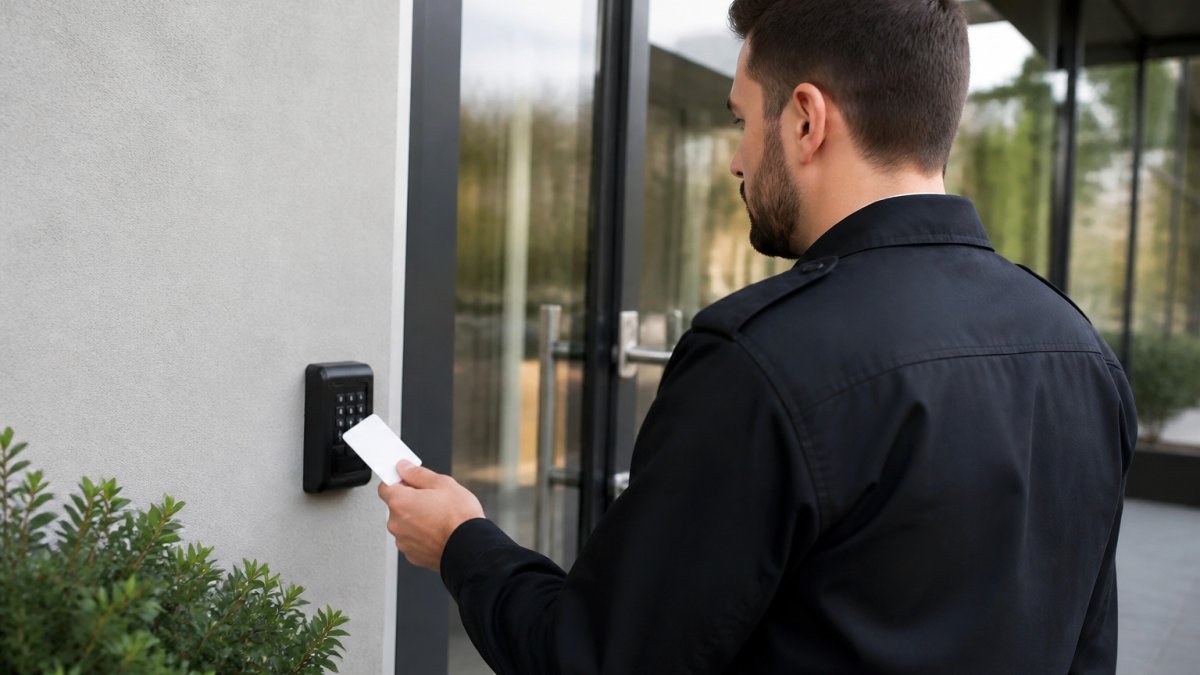
Effective gated community access control verifies every person and vehicle at the entry point, not just the unfamiliar ones.
An electronic gate with an intercom handles routine resident access; a guardhouse handles exceptions like contractors, guests, and one-time deliveries.
The most common failure is a shared gate code that circulates to every contractor and realtor in the community. Once it leaks, the code is worthless and nobody knows it.
Build a rule set for each access lane
The biggest access-control mistake is treating all arrivals as one category. Split them, and write the rule down:
| Arrival type | Verification method | Who approves | Typical failure |
|---|---|---|---|
| Resident vehicle | Transponder, decal, or license-plate reader tied to a resident record | Property manager on file | Sticker transfers when a car is sold |
| Resident guest | Pre-authorized guest list with name and expected window | Resident, via app or portal | Guest arrives outside the window and gets waved through |
| Recurring vendor (landscaper, pool, pest) | Badge or vendor pass with a scheduled day and time | HOA or property manager | Pass is shared with a subcontractor |
| One-time contractor | Call-ahead verification against a work order | Resident or manager | Guard admits on verbal claim alone |
| Delivery (parcel, food, grocery) | Package locker, delivery zone, or escorted entry | Policy set by board | Driver follows a resident vehicle through the gate |
| Emergency services | Pre-planned access route and gate override | Standing policy | Gate code not shared with dispatch |
That table is the document a board should hand a new guard on day one. If a lane has no written rule, the guard is improvising, and improvisation is where tailgating and unauthorized entry live.
Tailgating and piggybacking: the entry-point problem nobody budgets for
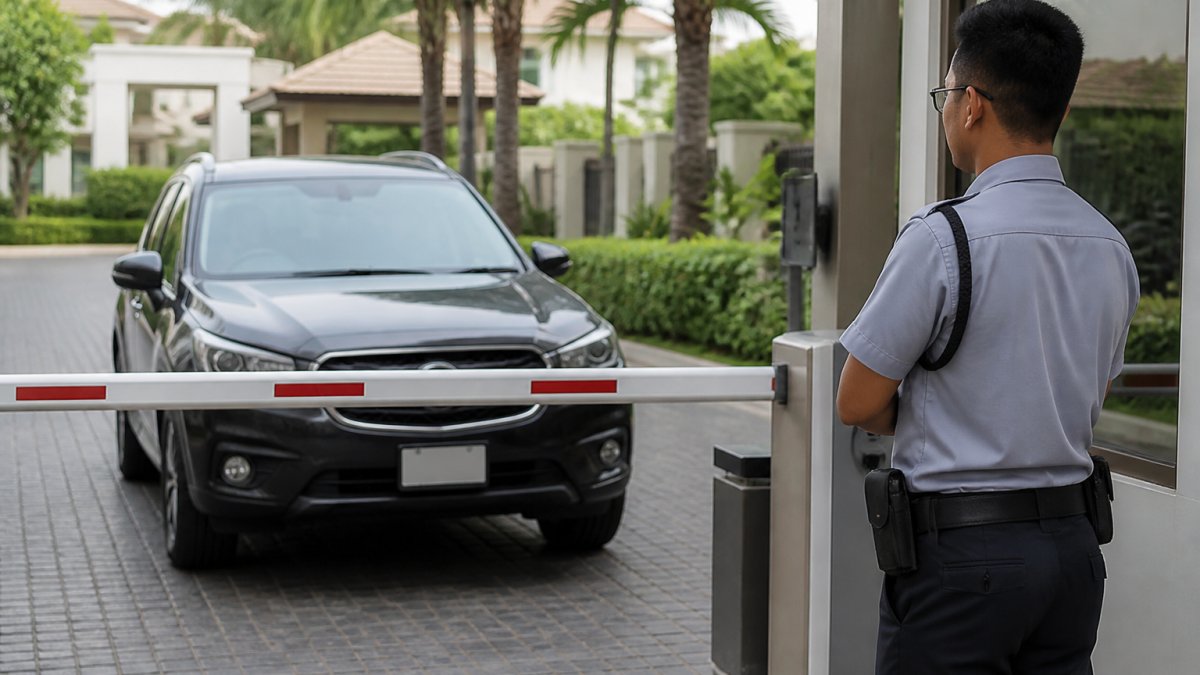
Tailgating, one vehicle following another through an open gate, is the most common physical breach at gated communities, and it is a design problem as much as a staffing one. Countermeasures that work:
- Anti-tailgate detection. Loops, beams, or camera analytics that flag a second vehicle crossing before the gate closes, paired with an audible or visual alert at the guardhouse.
- One-car-at-a-time geometry. A short entry lane with a gate that closes between vehicles removes the space a follower needs.
- Intercom verification at unstaffed lanes. A camera and two-way audio at every resident lane, not just the visitor lane, so an unfamiliar vehicle can be challenged without opening the gate.
Visitor, vendor, and delivery management in practice
The workflow matters more than the software:
- Pre-authorization. Residents enter guests and expected deliveries in a portal or app before arrival. The guard sees a name and window, not a surprise.
- Verification at the gate. The guard matches the arrival to the pre-authorization, checks photo ID for one-time contractors, and logs the entry time.
- Escort or restriction. One-time vendors are escorted or restricted to the work address; recurring vendors carry a visible pass tied to a scheduled day.
- Delivery containment. Parcel lockers, a staffed package room, or a designated delivery zone keep drivers from roaming the interior streets.
- Exit logging. Every entry has a matching exit record. An open entry with no exit is an incident, not a rounding error.
Vendors are the most common source of leaked codes and unescorted interior access. Keep a current vendor list, company name, insurance certificate, scheduled days, authorized individual, reviewed quarterly. When a vendor changes staff, the pass changes with them.
Technology that supports the gate, not replaces it
Access-control hardware is a layer, not a solution. Components that earn their place:
- Intercom and video at every lane, so a guard or remote operator can see and speak to an arrival before any barrier moves.
- Credentialed resident access (transponder, fob, or app-based) tied to a resident record that is deactivated when a household moves out, a step boards routinely forget.
- Visitor management software that logs pre-authorizations, arrivals, and departures in one place and produces an audit trail.
None of these replaces a guard's judgment at the exception lane. Technology should make routine arrivals fast so the guard has attention left for the ones that are not routine.
The audit question every board should ask
Once a quarter, pull the access logs and answer three questions: How many entries had no matching exit? How many arrivals were admitted without a pre-authorization or work order? How many times was the gate found open or faulted outside a scheduled window? Those numbers tell you more than any vendor presentation. If you cannot produce them, the system is collecting data nobody is using.
24/7 Gated Community Security: Guards, Patrols, and Coverage Gaps
True 24/7 gated community security means coverage through every shift, not just the hours that are convenient to staff. Guard services typically combine gatehouse staffing, visitor management, and patrols, and Guardian Security's residential community services describes exactly that mix for gated communities.
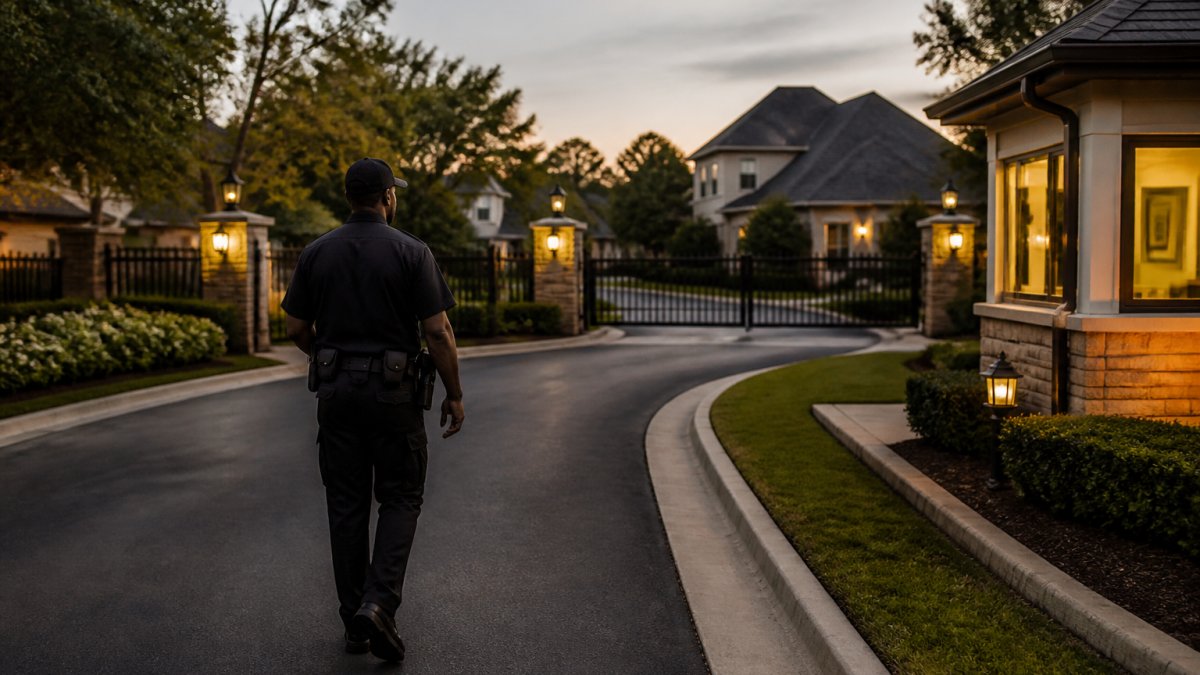
Coverage gaps usually appear at shift changes, overnight, and on weekends. A documented patrol schedule with randomized timing closes the predictability problem, and mobile patrol can supplement a fixed guardhouse in large or spread-out communities.
Gated Community Security Cost: What Drives the Price
Gated community security cost depends on coverage hours, entry points, whether posts are staffed or patrolled, and how much technology you layer in. Any provider quoting a flat number before walking the property is guessing.
Pricing scales with labor hours first: a staffed guardhouse running 24/7 requires multiple full-time posts to cover shifts legally and reliably, the largest line item. Cameras, alarms, electric fencing, and intercom hardware add upfront capital and monitoring fees. Mobile patrol is often the most cost-efficient layer for low-traffic hours.
Our advice: ask for a line-item breakdown separating labor, technology, and monitoring. That structure makes it far easier to compare providers on what you are actually paying for.
Contact us Today for a Quote →
Emergency Preparedness and Resident Privacy in Gated Communities
Two areas get skipped in most security plans: emergency response and who controls the footage afterward. Both deserve a written policy before the first camera goes up.
Emergency scenarios: write the procedure, not the binder
Emergency preparedness means a documented response plan covering medical calls, fire, severe weather, power outages, and unauthorized entry, with clear roles for guards and instructions for residents. Run it as a drill, not a binder on a shelf, a plan never exercised is a document, not a capability.
A workable plan assigns a named role to each scenario. The pattern most communities settle on:
| Scenario | Guard's first action | Resident instruction | Coordination point |
|---|---|---|---|
| Medical emergency | Call 911, open the emergency access route, escort EMS to the address | Stay clear of the entry lane; do not block the gate | Provide gate code and interior map to dispatch |
| Fire or smoke report | Confirm location, open access for fire apparatus, keep residents back | Evacuate via the posted route; do not re-enter | Meet the first-arriving engine at the gate |
| Severe weather | Secure the gatehouse, log the event, monitor for damage | Shelter per local guidance; report downed lines | Utility and public-safety contacts on file |
| Power outage | Switch the gate to manual or battery backup, staff the entry | Expect slower entry; carry credentials | Utility outage line; generator status |
| Unauthorized entry or intruder | Observe and report; do not confront beyond policy | Lock doors; call the guardhouse, then 911 | Law enforcement; preserve camera footage |
| Vehicle accident at entry | Secure the scene, direct traffic, call 911 if injuries | Use an alternate gate if available | Towing and public-safety contacts |
Two details separate a real plan from a generic one. First-responder access: dispatch needs the gate code, emergency lane, and interior map before an incident, not during one, confirm annually that the code on file is current. Alternate routes: if the main gate is blocked by a fire engine or fallen tree, the plan needs a second way in, and residents need to know it exists.
Measuring whether the plan works
A plan without metrics is a hope. Numbers worth reporting to the board quarterly:
- Response time from alarm or call to guard on scene, by shift and by gate.
- Access-control exceptions, entries admitted without pre-authorization or work order.
- Patrol completion rate against the documented schedule, including randomized timing.
A security provider should be willing to put these categories in a contract as service-level commitments. If they cannot report them, the community is buying presence, not performance.
Resident privacy and surveillance governance
Privacy and surveillance governance is the other half. Decide in writing who can view camera footage, how long it is retained, and how incident reporting is shared with the HOA and property manager. Residents accept cameras far more readily when they know the rules.
The governance questions a board should answer in writing before the first camera goes up:
- Purpose and placement. Cameras cover entries, exits, amenity areas, and perimeter, not the interior of homes or private yards. Publish the placement map.
- Access control to footage. A named list of who can view live and recorded video, with role-based permissions and an audit log of every view and export.
- Retention period. A defined window, commonly 30 days for routine footage, longer for footage tied to an open incident, after which it is purged on a schedule.
Legal, liability, and insurance questions to settle early
Guard licensing, use-of-force policy, contract terms, and liability allocation vary by state and locality, so treat these as questions for counsel rather than settled answers:
- Is the guard service licensed and insured in the jurisdiction, and are individual guards registered as required?
- Does the contract state the guard's authority, observe and report versus detain, and does the use-of-force policy match?
- Who carries liability for an incident at the gate, and does the community's insurance and the provider's insurance align without gaps?
A board that answers these before signing avoids the most common post-incident dispute: two insurance policies, each pointing at the other.
Accessibility and equitable access
A security plan that works only for able-bodied residents with smartphones is not a plan. Build in:
- An accessible entry procedure for residents with mobility limitations, including a staffed or call-button option at every lane.
- Emergency access that does not depend on a resident being able to reach the gate on foot.
- Consistent treatment of residents, guests, contractors, and delivery workers, the same verification standard applied to everyone, so access rules do not become a discretion problem at the guardhouse.
Residents accept cameras and access rules far more readily when the rules are written, applied evenly, and explained. That is the governance half of gated community security most service pages leave out.
Contact Tactical Guard Services for a Security Assessment
A security assessment tailored to your community beats any generic checklist. Every property has different entry points, traffic patterns, and gaps.
Tactical Guard Services provides professionally licensed security with 24/7 on-site operation at affordable pricing, built to protect homes and businesses with reliability and care. We start with an on-site walkthrough, identify the weak points in your current setup, and recommend a layered plan covering guards, patrols, access control, and emergency response.
Frequently Asked Questions
Can police enter a gated community?
Yes. Police can enter gated communities to respond to emergencies, pursue suspects, or investigate crimes. Gate staff should have a clear protocol for admitting law enforcement quickly while logging the entry. Residents sometimes assume a gate blocks police, but it does not. A written policy covering emergency vehicle access, contact numbers, and gate override procedures prevents delays when minutes matter.
How much does gated community security cost?
Gated community security cost depends on the services you choose: staffed guardhouses, mobile patrol, camera systems, access control hardware, and monitoring. A single guarded entry runs less than round-the-clock coverage at multiple gates. Tactical Guard Services does not publish flat rates because every community's layout and coverage needs differ. Request a quote for a breakdown based on your entry points, hours, and patrol schedule.
Should a gated community hire security guards?
Hiring guards makes sense when you need visible deterrence, visitor screening, and a fast response to incidents. A gate alone does not verify who enters. Guards staff the guardhouse, check vendor and delivery access, log suspicious activity, and coordinate with police. Communities with high traffic, prior property crime, or residents who want accountability at entry points benefit most from professional guard services.
How can an HOA improve visitor access control?
An HOA can improve visitor access control by combining an intercom system, a visitor management log, and clear resident access rules. Require residents to pre-authorize guests, issue temporary codes for vendors, and set delivery access windows. Review the log weekly for unauthorized entry attempts. Pair the system with staffed entry during peak hours so someone can verify identities rather than relying on a remote buzzer alone.
What security measures work best for gated communities?
Layered measures work best: access control at entry points, staffed guardhouses, mobile patrol, video surveillance, perimeter security such as fencing and lighting, and an emergency response plan. Security 101 recommends combining physical barriers, access control, video surveillance, personnel, and emergency planning rather than relying on a gate alone. Each layer covers a gap the others miss, from deterrence to incident reporting.
Do security guards reduce crime in gated communities?
Research on whether gates alone reduce crime is mixed, and the Crime and Justice Research Alliance frames the gated versus non-gated comparison as a test of the assumption that gated communities are safer. Guards add deterrence, visitor screening, and faster incident reporting, which gates cannot do. The strongest results come from combining guards with access control, cameras, and patrols rather than expecting one measure to carry the load.
Most gated communities are one tailgated entry or one leaked gate code away from a real incident. If your current setup relies on a barrier and hope, it is time for a proper assessment. Get started with Tactical Guard Services and build residential security for gated communities that holds up on the overnight shift, not just on paper.