 how-to
What Is a Good Emergency Security Guard Response Time?
Last Updated: October 26, 2026
Quick Summary
A good guard response time is set per incident severity, not as one number for the whole site. A practical starting table targets under 3 minutes for life-threatening incidents, under 5 minutes for crime in progress, under 10 minutes for property risk, and under 30 minutes for low priority. Treat these as a starting point and define targets per zone in the contract.
- Emergency response time runs from incident detection to a guard on scene taking action.
- Break every quoted number into notification, dispatch, and guard arrival stages.
- Alarm verification, address confirmation, and dispatcher handoffs are where minutes quietly disappear.
- Post the escalation tree at every guard station and include it in the post orders.
- Require timestamped logs for notification, dispatch, and arrival, and review them monthly.
Table of Contents
- What Emergency Security Guard Response Time Actually Measures
- Why Response Time Matters for Life Safety and Loss Prevention
- Security Guard Emergency Response Procedures, Step by Step
- Alarm Response Time in Security: Where the Minutes Disappear
- Security Patrol Response Time and the Coverage That Shapes It
- Building a Site-Specific Security Incident Response Plan
- How to Measure and Verify Response Times After Go-Live
- Request a Response-Time Quote for Your Site
- Frequently Asked Questions
What Emergency Security Guard Response Time Actually Measures
Emergency security guard response time is the total clock time from the moment an incident is detected to the moment a trained guard is physically on scene and taking action. According to RapidSOS's analysis of alarm response delays, the average home security alarm response time runs over 36 minutes, which is why the definition matters so much.
The Three Stages: Notification, Dispatch, and Guard Arrival
Most contracts quote one number. That number hides three different processes:
- Notification: how long it takes for the alarm or call to reach a human who can act
- Dispatch: how long until a guard is assigned and moving
- Guard arrival: how long until that guard is standing at the incident
A fast dispatch means nothing if notification took twelve minutes. Ask vendors to break the number down.
Why Response Time Matters for Life Safety and Loss Prevention
Minutes decide outcomes. A fire, medical emergency, or crime in progress worsens with every minute nobody is present. A break-in with a guard on scene in four minutes is a deterred attempt; one that waits twenty minutes is a completed theft.
There's a harder truth here too. A 2026 Noonlight report on emergency response and monitoring found that 35% of users cancel monitoring services because of false alarms or because they doubt their systems work. Slow, unverified response erodes trust fast.
Security Guard Emergency Response Procedures, Step by Step
Every site needs a written sequence, not a verbal understanding. The strongest procedures separate the first sixty seconds from what happens after the scene is stabilized and define decision points in advance.
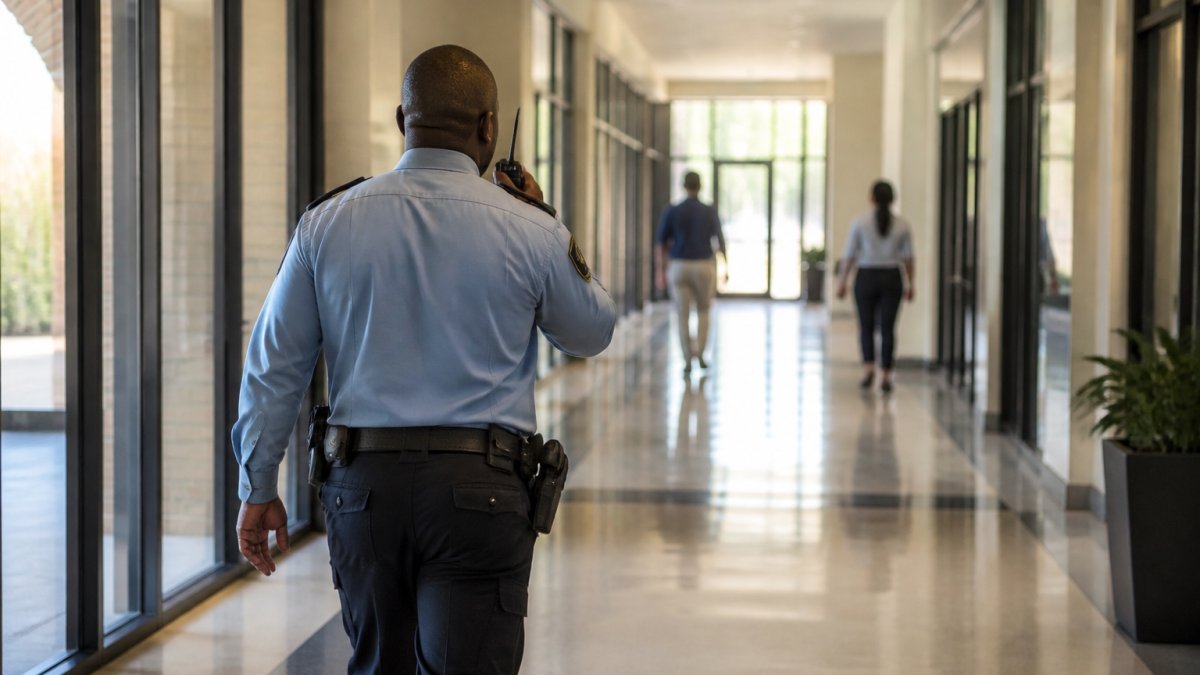
- Receive and confirm the alarm or report. The guard logs the notification time, confirms the exact location (building, floor, suite, door number), and repeats it back to the dispatcher. A guard sent to the wrong entrance on a multi-building campus can lose five to ten minutes.
- Assess from a safe distance before approaching. The guard stops at a cover point and gathers three facts: what is happening, how many people are involved, and whether weapons, fire, or hazardous materials are visible. This prevents the guard from becoming a second casualty.
- Transmit a situation report. Use a fixed format: location, nature of incident, number of subjects, weapons or hazards, injuries, and next action. Consistency lets the supervisor and dispatcher act on the first transmission instead of calling back.
- Escalate to law enforcement or emergency services when the incident warrants it. Write the threshold down rather than leaving it to judgment. A common pattern: call 911 first for any weapon, injury, fire, crime in progress, or intruder who refuses to leave, and notify the supervisor in parallel.
- Intervene within training and legal limits, prioritizing life safety. A guard's authority is generally limited to citizen's arrest and self-defense under state law, and rules vary by state. State which interventions are authorized (verbal de-escalation, observation and reporting, escorting people off the property) and which are not (restraint beyond policy, pursuit off the property, entering a structure with an active fire).
- Stabilize, preserve, and document. Once the scene is safe, the guard secures the area, preserves evidence by restricting access, and files an incident report before end of shift. Capture timestamps for notification, arrival, first action, and emergency-service arrival; those four make the response time verifiable later.
From Incident Assessment to Escalation Procedure
Incident assessment comes first, always. A guard who runs toward an unknown situation becomes a second victim. Trained guards confirm what they are facing, check for weapons or fire, then choose a response. The escalation procedure should spell out exactly when a guard calls 911 versus handling it in-house. Write that line down before an incident, not during one.
A practical escalation tree has three tiers. Tier 1 is guard-resolvable: noise complaints, minor trespass, a propped door, a suspicious person who leaves when approached. Tier 2 is guard-plus-supervisor: a trespasser who refuses to leave, a verbal altercation, a minor injury, a vehicle accident on the property. Tier 3 is emergency services first: any weapon, injury requiring medical treatment, fire or smoke, an active intruder, or a crime in progress. In Tier 3 the guard calls 911, gives a clear location and description, secures the perimeter if safe, and waits for responders rather than confronting the subject.
Communication with Supervisors, Dispatchers, and Emergency Services
Response time is a chain of handoffs, and each handoff is where seconds disappear. The guard-to-dispatcher link should use a dedicated radio channel or monitored phone line, not a personal cell. The dispatcher-to-supervisor link needs a named backup.
A common failure is the guard who calls 911 but cannot give a precise address because the site has multiple entrances. Pre-printed address cards at each post, with the nearest cross street, specific entrance name, internal emergency contact, and supervisor's direct line, eliminate that delay.
On-Site Arrival and First Action
Arrival is not the end of the clock; it is the start of the action clock. Define the first action by incident type. For a medical emergency, confirm the scene is safe, call 911 if not already done, and begin first aid within training (many guards are certified in CPR and AED use). For a fire alarm, investigate without entering a smoke-filled area, then evacuate the zone to the assembly point.
Evacuation and Crowd Control
Evacuation is where response time and crowd behavior intersect. A guard arriving in three minutes can still lose the advantage if the route is blocked or the assembly point is unclear. Assign each guard a zone, a route, and a sweep responsibility (restrooms, stairwells, closed offices), and name a secondary assembly point. Crowd control means directing flow, keeping exits clear, and preventing re-entry until the fire department or law enforcement authorizes it.
Alarm Response Time in Security: Where the Minutes Disappear
Alarm response time in security is rarely lost in one dramatic place. It leaks. A few seconds in alarm verification. A minute confirming the address.
Alarm verification alone can add real delay, because systems often wait to confirm a signal before alerting anyone. Add a rural coverage gap or a large property with one entrance, and the minutes stack up quietly.
Security Patrol Response Time and the Coverage That Shapes It
Security patrol response time depends on where guards actually are when something happens. Guard density built around patrol coverage means someone is always close; a thin schedule means the nearest guard may be twenty minutes away.
Contact us Today for a Quote →
Site proximity is the lever most property managers overlook. Urban coverage with multiple posts shortens guard arrival. Rural coverage with a single roving unit stretches it.
Building a Site-Specific Security Incident Response Plan
A security incident response plan is a written document that defines each incident severity level, the response-time target for each, and who does what. Generic plans fail because a data center and a gated community face different risks. Below is a common method to set targets a provider can meet and a site manager can verify.
How to Set a Site-Specific Response-Time Target
Start with a risk assessment: map entrances, blind spots, past incidents, operating hours, and where people or assets are most exposed. Then set targets by severity using four inputs:
- Site risk: what happens if the incident goes unaddressed for one minute, five minutes, or fifteen minutes. A life-safety risk justifies a tighter target than a property risk.
- Layout and access: a single-building site with one entrance is faster to cover than a multi-building campus with controlled access points. Travel time inside the property counts.
- Operating hours: a site that is occupied 24/7 needs continuous coverage; a site that is vacant overnight may accept a longer target in exchange for a lower cost.
A practical starting table looks like this:
| Incident Severity | Example | Target Guard Arrival | Escalation |
|---|---|---|---|
| Life-threatening | Medical emergency, fire | Immediate, under 3 minutes | 911 called first |
| Crime in progress | Break-in, assault | Under 5 minutes | Law enforcement coordination |
| Property risk | Trespass, alarm | Under 10 minutes | Supervisor notification |
| Low priority | Noise, minor damage | Under 30 minutes | Incident reporting only |
Treat those numbers as a starting point, not a universal benchmark. A site with a single guard and a large footprint may not hit a three-minute target at every corner, and a contract that promises it without a post at that corner is promising something the schedule cannot deliver. Set the target per zone, not per site, and state the zone in the contract.
What to Ask Before You Sign a Contract
Ask vendors to define each stage in writing: notification, dispatch, guard arrival, first action, and emergency-service arrival. Ask how they measure each stage and what timestamp source they use. Ask what happens during shift gaps and whether 24/7 coverage is truly staffed or just promised. A security-industry article from Priority First on security company response standards cites a common 5-to-15-minute range for on-site emergencies, but that is a general claim, not a verified benchmark.
The procurement questions that separate a real guarantee from a marketing line are these:
- Guaranteed response window: is the target a guarantee with a remedy, or a goal with no consequence? Ask for the remedy in writing.
- Exclusions: what incidents are excluded from the target? Common exclusions include simultaneous incidents, severe weather, road closures, and incidents at locations outside the defined zones.
- Escalation procedure: who does the guard call, in what order, and what is the backup if the first contact does not answer?
Response-Time Trade-Offs and Limitations
A fast arrival does not guarantee a safe outcome. Distance, access restrictions, simultaneous incidents, and responder safety all affect what a guard can do on arrival. A guard who arrives in two minutes but cannot enter a locked suite until a keyholder arrives has not resolved the incident in two minutes. A guard facing an armed subject should not intervene physically regardless of arrival time; the correct action is to contain, observe, and wait for law enforcement.
Practical Site-Level Improvements
Most response-time gains come from preparation, not from demanding that guards move faster. The measures that consistently shorten arrival and first action are:
- Access instructions: keys, codes, and access cards at every post, with a current keyholder list.
- Clear escalation trees: posted at each station and included in post orders.
- Strategically placed posts: a post near the highest-risk asset shortens arrival there, even if it lengthens it elsewhere.
How to Measure and Verify Response Times After Go-Live
Verification separates real service from marketing. Require timestamped logs for every alarm notification, dispatch, and guard arrival. Review them monthly against your targets.
A 2026 KPI analysis from Therms on security performance metrics lists incident response time and scheduled patrol completion rates among the core metrics to track. Pair those with spot audits and post-incident reviews. If a vendor can't show you the data, you don't have a response-time guarantee.
Request a Response-Time Quote for Your Site
Response times are a design decision, not a slogan. Set your targets by severity, verify them with real logs, and hold your provider to the numbers. Tactical Guard Services provides professionally licensed security service with 24/7 on-site operation at affordable pricing, built around your site's actual risk. Contact us today for a quote.
Frequently Asked Questions
What is a good emergency response time for a security guard?
There is no universal number, and you should be skeptical of any provider who quotes one without asking about your site. A reliable figure to work from is the 5-to-15-minute range that security-industry sources describe for on-site emergencies, but that is a general claim rather than a verified standard. Your guard response time target should reflect site size, layout, guard density, and whether the guard is already on site or dispatched from elsewhere. A gated community with a staffed gatehouse and a data center with 24/7 posts will land on different numbers.
How does alarm response time in security differ from EMS response time?
They are separate processes and should never be compared directly. RapidSOS attributes an average home security alarm response time of over 36 minutes to Harvard research, while a security-industry article gives a 5-to-15-minute range for on-site security-company emergencies. Those figures describe different things: an alarm signal traveling through a monitoring center and public dispatch versus a guard already on the property. Public emergency services handle fire, medical, and crime response; guards handle observation, deterrence, and initial incident assessment until law enforcement or EMS arrives.
What factors affect how quickly a security guard can respond?
Four factors dominate. First, site proximity and whether the guard is posted on site or patrolling a route. Second, guard density and patrol coverage, since one officer covering a large campus cannot be everywhere. Third, alarm verification, because unverified alarms trigger delays while a dispatcher tries to confirm the signal. Fourth, communication: supervisor notification, dispatcher communication, and law enforcement coordination all consume minutes. Urban coverage tends to be faster than rural coverage for the same reason, travel distance. Ask any provider to walk you through each stage for your specific property.
How can a business improve its security incident response plan?
Start by defining what counts as an emergency at your site and who decides. Map the escalation procedure for a medical emergency, fire emergency, crime in progress, and workplace violence separately, because the sequence differs. Then measure: a 2026 KPI article lists incident response time and scheduled patrol completion rates as core metrics, so require both in your reporting. Add access control, perimeter security, and clear evacuation and crowd control assignments. Finally, test the plan with a drill and record actual minutes to respond at each stage, not just the total.